Loading article
IoT Company in Chandigarh: Industrial IoT Solutions and Automation Services for Modern Businesses
Looking for an IoT company in Chandigarh? Explore industrial IoT solutions, smart monitoring systems, PLC integration and automation services by Systechnia.
Systechnia Technology LLP·30 October 2026·13 min read
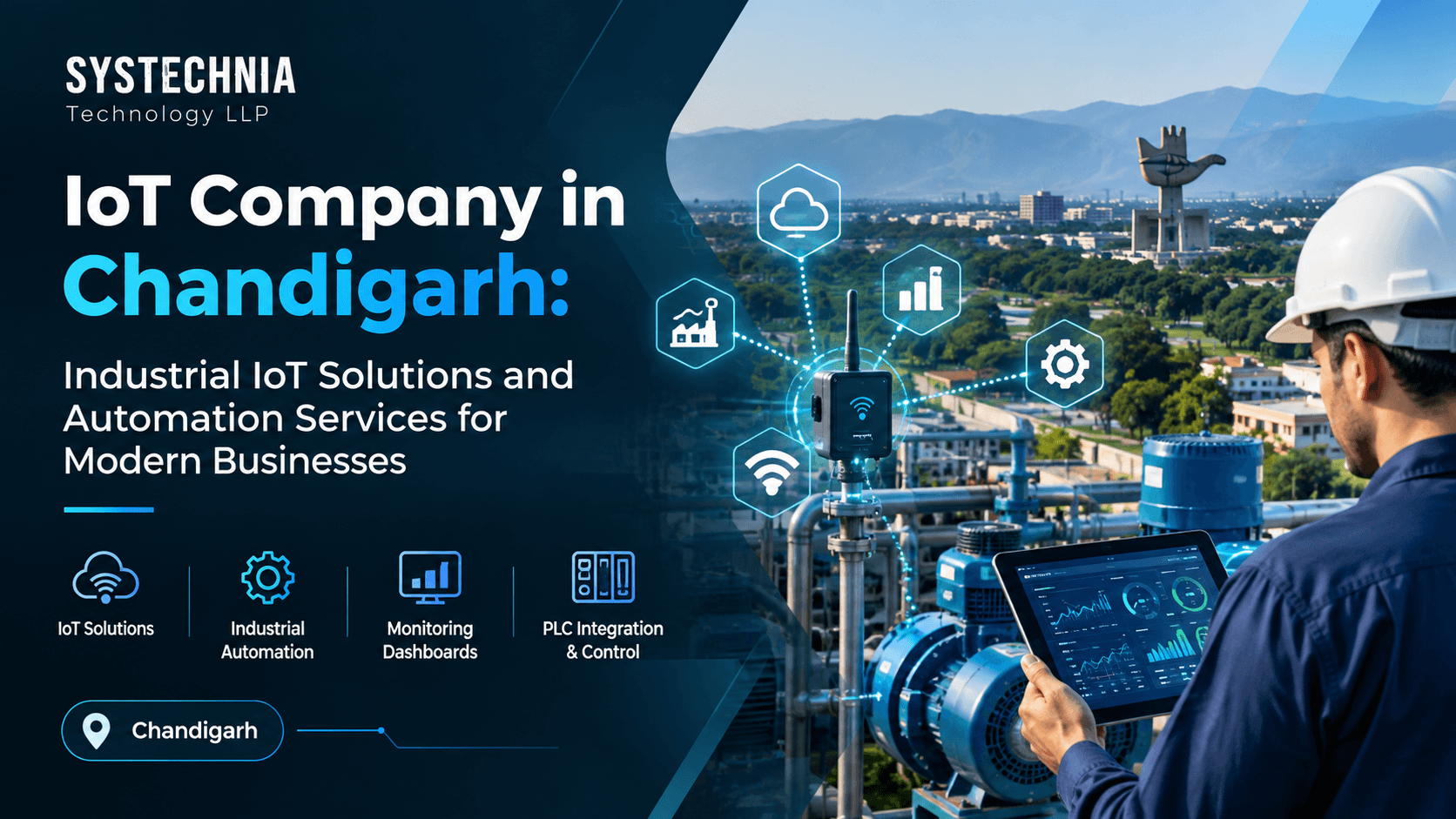
Technology is changing the way businesses operate. From manufacturing units and industrial facilities to engineering institutions, organisations are increasingly looking for smarter ways to monitor equipment, manage processes, and make better operational decisions.
Many businesses still depend on manual inspections, disconnected machines, handwritten records, and traditional control systems. While these methods may work for basic operations, they can make it difficult to get a clear picture of what is happening across a facility, especially when operations involve multiple machines, sensors, and processes.
This is where the Internet of Things (IoT) and industrial automation become valuable.
By connecting physical equipment with sensors, controllers, software, and monitoring dashboards, businesses can collect useful operational data and make information easier to access. Industrial automation takes this further by helping organisations manage repetitive processes through programmed control systems.
For businesses exploring these technologies, choosing the right engineering partner matters. An effective solution needs more than connected devices or a software dashboard. It requires the right combination of hardware, firmware, software integration, system design, and practical implementation.
Systechnia Technology LLP works across IoT systems, industrial automation, embedded product development, and connected software solutions. For organisations in Chandigarh looking to explore smarter monitoring and automation, these technologies can provide a practical starting point for improving how equipment and processes are managed.
Why Are Businesses in Chandigarh Exploring IoT and Industrial Automation?
Industrial and commercial operations generate information every day. Temperature readings, equipment status, energy consumption, machine conditions, production parameters, and other measurements can all help businesses understand how their systems are performing.
However, collecting this information is only useful when it can be accessed, understood, and acted upon.
Consider a manufacturing facility where an operator needs to check several machines throughout the day. Without a connected monitoring arrangement, employees may have to visit individual machines, record readings manually, and report unusual conditions separately.
A connected IoT monitoring system can bring relevant information into one place.
Depending on the application, sensors and controllers can collect measurements and transfer them to a local or remote monitoring interface. Operators can then view current readings, review historical information, and receive alerts when configured conditions require attention.
Businesses may explore industrial IoT and automation for several reasons:
Better equipment visibility: View selected machine parameters without relying entirely on manual inspections.
Centralised monitoring: Bring information from different sensors or equipment into a common dashboard.
More organised data collection: Maintain digital records of measurements and operating conditions.
Faster identification of unusual conditions: Use configured alerts to bring attention to readings that need investigation.
Repeatable process control: Apply programmed logic to suitable industrial processes.
Informed operational decisions: Use historical readings and current information to understand equipment behaviour.
The actual benefits depend on the equipment, sensors, application, network conditions, and quality of implementation. IoT should solve a clearly identified operational problem rather than being introduced simply because it is a popular technology.
What Does an Industrial IoT Solution Actually Include?
Industrial IoT, often called IIoT, refers to the use of connected technologies in industrial and operational environments.
Unlike a basic consumer IoT device, an industrial solution must account for practical working conditions, equipment compatibility, data reliability, operational requirements, and the needs of the people using the system.
A typical industrial IoT solution can include several connected components.
1. Smart Sensors and Data Acquisition
Sensors are the starting point of many IoT monitoring systems.
They collect information from the physical environment or connected equipment. Depending on the application, this may include temperature, humidity, pressure, vibration, voltage, current, or other measurable parameters.
The appropriate sensor depends on what the business wants to monitor.
For example, a facility interested in environmental conditions may require temperature and humidity sensors, while an electrical monitoring application may need suitable voltage and current measurement arrangements.
Sensor selection is important because inaccurate measurements or unsuitable hardware can affect the usefulness of the complete system.
Systechnia works with sensor selection, interfacing, and field data acquisition as part of its IoT and automation capabilities.
2. Data Logging and Historical Records
Real-time information helps operators understand current conditions, but historical data is equally important.
A data logging system records measurements over a selected period. This allows teams to review previous readings instead of depending entirely on manual notes or isolated observations.
For example, a monitoring system may record equipment temperature at configured intervals. An operator can later review these records to understand how readings changed during different operating periods.
Depending on the project, data can be stored locally and synchronised with a remote system.
Local logging is particularly worth considering in environments where internet connectivity may not always be available. The system should have a defined approach to retaining records and reconnecting when communication becomes available again.
3. Centralised Monitoring Dashboards
Collecting data from sensors is only one part of the solution. Operators also need a practical way to understand that information.
A monitoring dashboard can display selected parameters, equipment status, historical readings, and configured alerts through a single interface.
For example, an industrial dashboard may show:
Current sensor readings.
Equipment operating status.
Historical measurement trends.
Device connectivity information.
Configured warning conditions.
Data from multiple monitoring points.
The dashboard should be designed around the actual needs of its users.
A plant operator may need a simple equipment status view, while a maintenance or management team may require historical information and additional reporting features.
The objective is to turn raw device data into information that people can use.
4. Remote Monitoring and Alerts
Connected monitoring systems can make selected operational information available beyond the physical location of the equipment.
Depending on the system architecture and network availability, authorised users may be able to access readings through a remote dashboard.
Alert functionality can also be configured for specific conditions.
For instance, an operator may want to receive a notification when a measured temperature exceeds a defined threshold or when a connected device stops reporting data.
These alerts do not replace physical inspections or maintenance procedures. Instead, they provide another source of information that can help teams decide when further investigation is required.
5. PLC and Controller Integration
Many industrial facilities already use programmable logic controllers, electrical control panels, and other automation equipment.
Introducing IoT does not always mean replacing an existing setup.
A properly planned solution can work with suitable existing sensors and controllers, or add new hardware where the application requires it.
PLC and controller integration can connect industrial control activities with monitoring and data collection systems.
This creates opportunities to bring equipment information into a common interface while retaining the control arrangements required by the process.
The integration method should be selected after understanding the existing equipment, signals, communication requirements, and operational constraints.
Industrial Automation Services: Making Processes More Consistent
Industrial automation involves using control systems, controllers, electrical hardware, and programmed logic to manage specific operations.
Its purpose is not simply to reduce manual work. A well-designed automation system should make a process more structured, repeatable, and easier to supervise.
For organisations looking for industrial automation services in Chandigarh, it is useful to understand the different areas where automation can be applied.
PLC-Based Automation
A programmable logic controller, or PLC, is an industrial controller used to execute programmed instructions based on inputs and operating conditions.
PLC-based systems are used in many types of industrial applications, including:
Machine sequencing.
Motor control.
Conveyor operations.
Process interlocks.
Equipment status monitoring.
Automated switching and control sequences.
The PLC program must reflect the actual process requirements. Inputs, outputs, operating conditions, interlocks, and safety-related requirements should be considered before implementation.
Industrial Monitoring and Control
Industrial monitoring helps teams understand what is happening across their equipment and processes.
A monitoring arrangement may include sensors, controllers, data acquisition hardware, and software dashboards.
Depending on the application, users may be able to view selected process measurements, equipment states, and configured warning conditions.
Monitoring and control should be planned carefully. A dashboard that displays information and a controller that directly manages machinery have different responsibilities and must be engineered accordingly.
Process Interlocks and Supervised Control
Some industrial operations require specific conditions to be satisfied before the next step can begin.
Process interlocks help define these operating conditions.
For example, a sequence may require a particular input or machine state before another operation is permitted. These conditions can be implemented through appropriate control logic and hardware.
The design must account for the process, equipment specifications, and applicable safety requirements. Safety-critical functions require proper engineering, validation, and suitable safety-rated components where necessary.
Connected Equipment and Data Integration
Industrial environments often contain equipment from different manufacturers and generations.
Bringing information from these systems together can be challenging.
An IoT integration project may involve understanding the available signals, selecting compatible interfaces, configuring controllers, developing data collection logic, and presenting the information through a common dashboard.
The best approach is generally to assess the existing infrastructure before deciding what needs to be added or changed.
Practical Applications of Industrial IoT Solutions
Industrial IoT is not limited to one sector. Its applications depend on the process, measurements required, and the operational problem a business wants to address.
Here are some examples of where connected monitoring and automation can be considered.
1. Manufacturing Equipment Monitoring
Manufacturing facilities may use connected sensors to observe selected equipment parameters.
Depending on the machine and application, this could include temperature, vibration, electrical measurements, or operating status.
Historical readings may help maintenance teams investigate recurring changes or unusual behaviour.
2. Energy and Electrical Monitoring
Electrical monitoring systems can collect selected information about electrical parameters.
Depending on the design, dashboards may display readings from different monitoring points and maintain historical records.
This can help authorised teams review electrical conditions and identify areas that require further analysis.
3. Environmental Monitoring
Industrial and commercial facilities may need to monitor environmental conditions in different areas.
Connected temperature, humidity, and other suitable sensors can provide digital readings that are available through a central interface.
This can be useful for facilities where environmental records are part of regular operational procedures.
4. Utility and Infrastructure Monitoring
Water systems, utility equipment, and campus infrastructure may contain multiple monitoring points.
An IoT-based approach can help collect information from selected locations and make it available through a common monitoring interface.
The specific hardware and communication arrangement should be chosen according to the site environment.
5. Research and Engineering Facilities
Engineering institutions and research environments also benefit from connected measurement systems.
Students and technical teams can use sensors, controllers, data logging, and dashboards to understand how physical systems interact with software.
These technologies also create opportunities for practical learning in IoT, embedded systems, and automation.
Why Choose the Right IoT Company in Chandigarh?
Selecting an IoT company is an important decision because the quality of the initial design can influence the reliability, usability, and future development of the complete system.
A company may offer sensors, software, controllers, or individual electronic components. However, an industrial IoT project often requires these elements to work together.
Before selecting a technology partner, consider the following factors.
Understanding of Hardware and Software
An IoT solution connects the physical world with software.
The technology partner should understand how sensors, controllers, embedded hardware, data collection, and dashboards interact.
This makes it easier to plan the complete system instead of treating each component as a separate activity.
Customised System Design
Industrial requirements are rarely identical.
A business may need to monitor a few parameters, integrate existing equipment, develop a custom controller, or build a complete monitoring arrangement.
A useful engineering approach starts by understanding the application and defining the system around that requirement.
Integration with Existing Equipment
Replacing an existing system may not always be necessary.
Where technically feasible, suitable sensors, controllers, and equipment can be integrated into a new monitoring or data collection arrangement.
This requires a proper assessment of compatibility, available interfaces, and operating constraints.
Documentation and Technical Handover
A system should remain understandable after installation.
Documentation, operating instructions, system configuration details, and appropriate training help operators and technical teams work with the installation.
These details should be considered part of the implementation rather than an afterthought.
Support and Future Development
Businesses may need to modify their monitoring requirements as equipment and operations change.
A solution should therefore be planned with appropriate scope for maintenance, future integration, and upgrades.
Discussing these requirements at the beginning can help avoid unnecessary redesign later.
How Systechnia Approaches IoT and Industrial Automation Projects
Systechnia Technology LLP brings together hardware engineering, embedded development, software systems, IoT solutions, and educational engineering setups.
Its approach focuses on building systems around actual requirements rather than offering disconnected technology components.
The implementation process can be understood through five stages.
Step 1: Understanding the Requirement
Every project starts with understanding the application.
What needs to be monitored? Which equipment is involved? What information should operators see? Is automation required, or is monitoring sufficient?
These questions help establish the scope and identify practical constraints.
Step 2: Designing the System
Once the requirements are understood, the hardware and software architecture can be planned.
This may include sensor selection, controller specifications, data acquisition arrangements, logging requirements, dashboard functionality, and system integration.
Step 3: Building and Integrating
The selected hardware, firmware, software, and interfaces are developed and integrated according to the project requirements.
The goal is to make the complete system work as a connected arrangement rather than a collection of unrelated components.
Step 4: Installation, Commissioning, and Training
Where included in the project scope, the system can be installed and commissioned at the relevant site.
Operators and technical teams should receive the orientation needed to understand the equipment, monitoring interface, and normal operating procedures.
Step 5: Documentation and Support
A technical handover should include relevant documentation and operating information.
Follow-up support, maintenance guidance, and future changes can then be discussed according to the project requirements.
IoT Solutions for Chandigarh, Mohali, and Panchkula Businesses
Organisations across the Chandigarh Tricity region have different technical requirements.
A manufacturing business may be interested in monitoring equipment, while an engineering company may need a custom embedded product. An educational institution may want an IoT or PLC laboratory where students can work with real hardware and measurement systems.
These requirements call for different solutions, even though they may use similar underlying technologies.
Systechnia works across several connected engineering areas:
IoT and Automation: Smart sensors, data loggers, monitoring dashboards, connected devices, and industrial automation.
Software Development: Custom web, desktop, and cloud software, data visualisation, analytics, and device integration.
Product and Embedded Development: PCB design, firmware, microcontrollers, prototyping, testing, and product engineering.
Educational Trainer Systems: Practical learning systems for IoT, robotics, automation, renewable energy, and power electronics.
For businesses and institutions in Chandigarh looking to explore these capabilities, the first step is to define the actual requirement and determine the appropriate technical approach.
Location-specific installation and service availability should be confirmed during the project discussion.
Frequently Asked Questions
1. What does an IoT company in Chandigarh do?
An IoT company designs and develops connected systems that allow devices, sensors, and equipment to collect and exchange data. Services may include sensor integration, data acquisition, monitoring dashboards, remote data access, embedded development, and industrial system integration.
2. What are industrial IoT solutions?
Industrial IoT solutions use connected sensors, controllers, networks, and software to collect and monitor information from industrial equipment and processes. They can support equipment monitoring, data logging, operational visibility, and configured alerts.
3. How is industrial automation different from IoT?
Industrial automation focuses on controlling and managing processes using controllers, electrical systems, and programmed logic. IoT focuses on connecting devices and collecting or sharing operational data. The two technologies can work together in an integrated industrial system.
4. Can IoT systems work with existing industrial equipment?
In many cases, yes. Suitable existing sensors, controllers, and equipment may be integrated into a new monitoring system. However, compatibility depends on available interfaces, equipment specifications, and the project requirements.
5. What industries can benefit from industrial IoT?
Manufacturing, electrical infrastructure, utilities, research facilities, commercial buildings, and other sectors can explore industrial IoT applications. The suitable solution depends on what needs to be measured, monitored, or controlled.
6. Can industrial IoT systems work without a continuous internet connection?
A system can be designed with local data storage and remote synchronisation where appropriate. This allows selected information to remain recorded during network interruptions, depending on the hardware and system architecture.
7. What should businesses consider before implementing an IoT solution?
Businesses should identify the operational problem, parameters to be monitored, existing equipment, sensor requirements, data storage needs, network conditions, dashboard requirements, and future integration plans before selecting a solution.
8. Does Systechnia offer both IoT and industrial automation solutions?
Systechnia lists IoT and automation capabilities that include sensor selection and interfacing, field data acquisition, data logging, monitoring dashboards, PLC and controller integration, commissioning, documentation, and operator training.
Looking for an IoT and Industrial Automation Partner?
Industrial technology is most useful when it addresses a real operational requirement.
Whether your organisation wants to monitor equipment, collect field data, integrate existing controllers, develop a connected device, or explore a customised automation system, the process should begin with a clear understanding of the application.
Systechnia Technology LLP brings hardware, embedded engineering, software, and automation capabilities together to develop practical technical solutions.
If your business is exploring industrial IoT solutions or automation services in Chandigarh, get in touch with Systechnia to discuss your requirements, technical scope, and possible implementation approach.
Have a system to monitor, automate, or develop?
Visit Systechnia and use the contact form to discuss your project.
Keep reading
Related articles
Systechnia Technology LLP
@systechnia·8d
How IoT-Based Industrial Monitoring Systems Help Businesses Track Equipment in Real Time
Discover how IoT-based industrial monitoring systems track equipment performance, collect sensor data, send alerts, and help businesses make informed maintenance decisions.
Have a system or lab to build?
Tell us what you want to monitor, automate, develop, or teach.