Loading article
How IoT-Based Industrial Monitoring Systems Help Businesses Track Equipment in Real Time
Discover how IoT-based industrial monitoring systems track equipment performance, collect sensor data, send alerts, and help businesses make informed maintenance decisions.
Systechnia Technology LLP·28 October 2026·16 min read
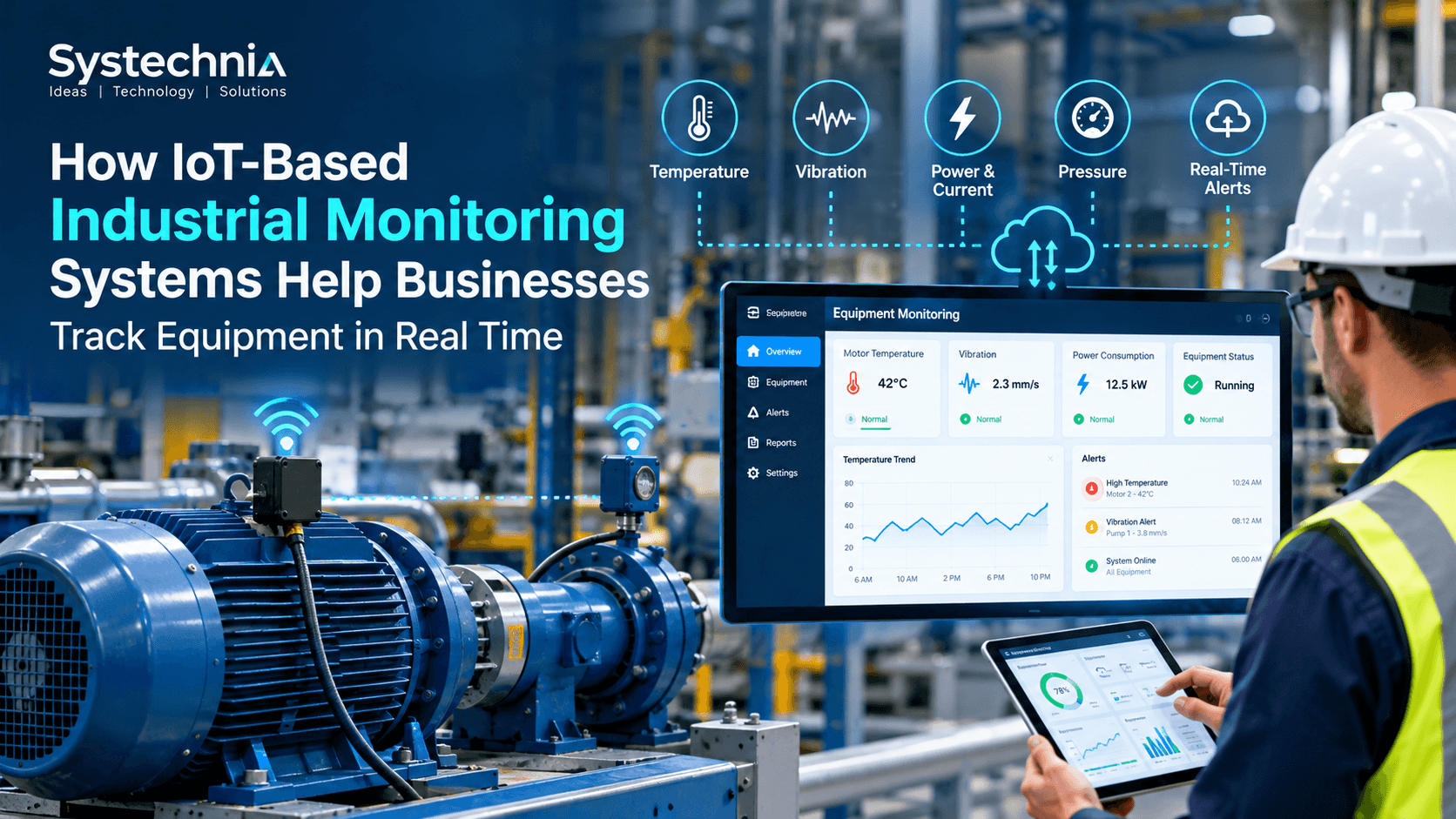
Imagine managing a factory where several machines operate throughout the day. Each machine has different operating conditions, maintenance requirements, and performance levels. If a motor begins overheating or a machine starts vibrating more than usual, how quickly would your team notice the change?
In many industrial environments, equipment problems are discovered during routine inspections or after production has already been affected. This can make it difficult for maintenance teams to identify developing issues early and understand what happened before a machine stopped working.
IoT-based industrial monitoring systems help businesses gain better visibility into their equipment by collecting sensor data and presenting it through connected monitoring dashboards. Instead of relying entirely on manual inspections, teams can track important operating parameters, review historical readings, and receive alerts when monitored conditions move outside defined limits.
From manufacturing plants and industrial facilities to utilities and equipment testing environments, the Internet of Things (IoT) is creating practical opportunities to make equipment monitoring more connected, organised, and data-driven.
In this article, we explore how industrial IoT monitoring works, which components are involved, where businesses can use it, and what to consider before implementing a system.
What Is an IoT-Based Industrial Monitoring System?
An IoT-based industrial monitoring system is a connected arrangement of sensors, controllers, communication devices, data logging systems, and software that collects and displays information about industrial equipment.
The purpose is straightforward: help people understand what their machines are doing without having to check every parameter manually.
Depending on the equipment and application, a monitoring system can track measurements such as:
Machine temperature and surrounding environmental conditions.
Vibration levels and other indicators of mechanical behaviour.
Electrical parameters, such as voltage, current, and power consumption.
Pressure, flow rate, and other process measurements.
Operating hours, machine status, and production-related data.
Equipment availability and communication status.
The information is transmitted to a local computer, industrial gateway, monitoring dashboard, or cloud-based platform, depending on the system design.
For example, a maintenance manager could review the temperature of several motors from one dashboard rather than walking around the facility to check each machine individually. If the system is configured with suitable thresholds and notifications, an unusual reading can also trigger an alert for further inspection.
The exact information available depends on the sensors installed, the equipment interfaces, and the monitoring requirements.
How Does Industrial IoT Monitoring Work?
An industrial monitoring system connects physical equipment with software that makes operational information easier to understand. Although the implementation varies from one industry to another, the process generally follows five stages.
1. Sensors Collect Equipment Data
The process begins with sensors that measure specific physical parameters.
A temperature sensor can monitor the surface or operating environment of a machine. A vibration sensor can measure mechanical movement. Current sensors can help track electrical load, while pressure sensors can monitor pressure within a suitable industrial process.
The sensor selection depends on the machine, measurement range, operating environment, and level of accuracy required.
Existing equipment may already provide useful information through built-in sensors or controllers. In other cases, additional sensing hardware may be needed to collect the required measurements.
The objective is to collect meaningful data rather than install sensors without a clear monitoring purpose.
2. Controllers and Gateways Process the Information
Once the measurements are collected, a controller or data acquisition device reads the sensor signals.
Depending on the application, this may involve a microcontroller, an industrial controller, a PLC interface, or an industrial IoT gateway.
The device can convert raw sensor signals into usable values, apply basic validation, record timestamps, or prepare the information for transmission.
An industrial gateway may also help connect equipment that uses different communication methods. This is particularly useful when a business wants to monitor existing machines rather than replace its entire infrastructure.
For example, a factory may have a PLC controlling a production process. A separate monitoring layer could read selected operating data from that controller and make it available on a dashboard.
Monitoring and control should be designed carefully. Sending equipment data to a dashboard does not automatically mean the monitoring system can safely control the machinery. Any control capability requires appropriate engineering, permissions, interlocks, and safety measures.
3. Data Travels Through a Communication Network
The collected information must reach the application that stores or displays it.
Depending on the installation, communication may use Ethernet, Wi-Fi, cellular connectivity, or industrial protocols such as Modbus and OPC UA. MQTT may be used for lightweight message exchange between connected devices and software platforms.
The right option depends on factors such as communication distance, network reliability, existing equipment interfaces, data volume, and site conditions.
A machine installed inside a factory may have access to a wired industrial network. Equipment located across multiple facilities may require a different connectivity approach.
Network design matters because even a well-designed sensor system becomes less useful if data arrives inconsistently or communication failures go unnoticed.
For systems that need to keep records during connectivity interruptions, local data logging and reliable reconnection mechanisms can help preserve useful operating history.
4. A Monitoring Dashboard Presents the Data
Raw sensor readings are not always easy to interpret. A dashboard organises them into information that operators and managers can use.
A typical industrial IoT monitoring dashboard may show:
Current equipment readings and operating status.
Historical data in charts and tables.
Configured warning and alarm conditions.
Equipment communication status.
Trends across different machines or locations.
Reports that help teams review performance over time.
Consider a production facility with several pumps. A dashboard could display their operating status, selected pressure readings, motor temperature, and recent alerts in one place.
A technician could then compare the current readings with previous measurements and decide whether an inspection is necessary.
A well-designed dashboard should prioritise the information that matters to the people using it. Operators may need immediate status indicators, while maintenance managers may be more interested in trends, event histories, and recurring issues.
5. Alerts Help Teams Respond to Unusual Conditions
One of the practical benefits of industrial IoT monitoring is the ability to configure alerts around important operating conditions.
For example, if a monitored temperature exceeds a specified threshold, the system can create an alarm or notify the appropriate person. A communication alert could also indicate that a sensor or gateway has stopped sending data.
These notifications help teams identify conditions that need attention without continuously watching every reading.
However, an alert is only useful when its threshold is appropriate and the underlying data is reliable. Poorly configured thresholds can generate excessive notifications, while overly broad limits may fail to highlight meaningful changes.
Businesses should define who receives each alert, how it should be acknowledged, and what action should follow.
Key Benefits of IoT-Based Industrial Monitoring Systems
Implementing IoT monitoring is not simply about putting machine readings on a screen. Its real value comes from helping people make better operational decisions.
1. Better Visibility Into Equipment Performance
When equipment data is collected and organised in a central location, teams can see operating conditions more clearly.
This is particularly useful when machines are spread across a large facility or when several locations need to be monitored.
Instead of depending entirely on occasional inspections, authorised staff can review available readings and identify which equipment needs closer attention.
Remote access can make this information easier to reach, provided that the system includes suitable network access controls and security measures.
2. Earlier Identification of Potential Equipment Problems
Machines can show changes in their operating behaviour before an obvious failure occurs. A rise in temperature, an unusual vibration pattern, or a gradual change in electrical consumption may justify further investigation.
An IoT monitoring system can help make these changes visible by collecting measurements and allowing teams to compare them with expected operating conditions.
This does not guarantee that every failure can be detected in advance. The effectiveness of monitoring depends on the selected sensors, data quality, suitable thresholds, and the ability to interpret the results correctly.
Nevertheless, continuous or appropriately frequent monitoring can provide maintenance teams with useful evidence that might otherwise be missed between inspections.
3. More Informed Maintenance Planning
Maintenance decisions are easier to evaluate when teams have access to reliable equipment histories.
Recorded data can help technicians understand whether a reading is unusual, whether a problem has occurred repeatedly, or whether operating conditions have changed over time.
This supports condition-based maintenance, where inspection or maintenance decisions are informed by the observed state of equipment.
More advanced predictive maintenance uses historical operating data, suitable analytical techniques, and sometimes machine-learning models to estimate the likelihood of a future problem.
It is important to distinguish the two approaches. A dashboard displaying temperature readings is a monitoring tool; it does not become a predictive maintenance system simply because it collects data continuously.
4. Reduced Dependence on Manual Data Collection
Manual inspections remain important, particularly for safety-critical equipment and measurements that require physical examination. However, recording every reading by hand can be time-consuming when many assets need to be checked.
Automated data collection can reduce repetitive recording tasks and help establish a more consistent history of equipment performance.
Staff can spend less time compiling routine readings and more time investigating exceptions, checking equipment, and carrying out necessary maintenance.
The level of time saved will depend on the original process and how well the new system is integrated into daily operations.
5. Improved Operational Decision-Making
Historical data helps businesses understand how their equipment behaves under different conditions.
For example, a maintenance team might compare motor temperature during different operating loads, review pressure fluctuations, or examine when communication failures occurred.
These insights can support more informed decisions about inspection schedules, operating practices, equipment upgrades, and troubleshooting.
The objective is not to collect the largest possible amount of data. It is to collect the right measurements and make them accessible to the people responsible for acting on them.
6. Monitoring Across Multiple Equipment Locations
Some businesses operate machinery across different production areas, facilities, or remote sites.
A connected monitoring architecture can bring selected readings from these locations into a shared interface. This gives authorised teams a more consistent view of equipment status and helps them prioritise attention.
Multi-location monitoring requires careful planning around connectivity, user permissions, device identification, data retention, and communication reliability.
A shared dashboard should make it clear which machine produced a reading, when the measurement was recorded, and whether the data is current.
Real-World Applications of Industrial IoT Monitoring
Industrial monitoring can be adapted to many applications. The sensors, measurements, and alert rules should be chosen according to the actual operating conditions.
Manufacturing and Production Equipment
Factories can use IoT monitoring to track selected parameters from motors, pumps, compressors, conveyors, and other production equipment.
For instance, monitoring vibration and temperature may help maintenance staff identify changes that warrant investigation. Recording machine operating hours can also support maintenance scheduling.
The monitoring system can complement existing production controls without necessarily replacing them.
Motors, Pumps, and Rotating Machinery
Rotating equipment is often monitored using temperature, vibration, current, pressure, or flow measurements, depending on the machine and the potential failure modes.
A sudden change in a monitored reading can prompt an inspection. Historical records can help technicians compare the event with earlier operating conditions.
Sensor placement, measurement quality, equipment characteristics, and appropriate alarm limits are important for drawing meaningful conclusions.
Utilities and Infrastructure
IoT monitoring may be useful for water systems, electrical infrastructure, environmental conditions, and other utility-related applications.
Depending on the installation, a system can record flow, pressure, temperature, electrical measurements, or equipment status.
The collected information helps operators review conditions across different points and investigate unusual readings. Critical infrastructure applications require appropriate reliability, security, and operational safeguards.
Environmental and Storage Monitoring
Facilities that need to maintain particular environmental conditions can use connected sensors to monitor temperature, humidity, or other relevant parameters.
Examples include selected storage areas, laboratories, and controlled indoor environments.
Alerts can notify staff when readings move outside defined limits, while historical logs help them review when conditions changed.
Whether the system is suitable for a regulated environment depends on its measurement accuracy, calibration, validation, recordkeeping, and applicable compliance requirements.
Engineering and Testing Laboratories
Engineering laboratories can use connected sensing and data logging to record measurements during experiments and equipment tests.
A dashboard can display live readings, while stored records help students, engineers, and instructors review how a system behaved during a test.
This application connects industrial IoT concepts with practical learning in sensor integration, embedded systems, networking, and data visualisation.
IoT Monitoring vs Traditional Equipment Monitoring
Both traditional monitoring and IoT-based monitoring have a place in industrial operations. The right choice depends on the equipment, cost, operating risks, and information required.
FeatureTraditional approachIoT-based approachData collectionOften manual or through local instrumentsSensor readings can be collected automaticallyVisibilityMay require physical inspection or access to local displaysConnected readings can be available through a dashboardHistorical recordsMay rely on manual logs or separate systemsData can be stored systematically when configuredAlertsMay depend on local alarms or operator checksConfigurable alerts can be delivered to selected usersMultiple locationsInformation may be spread across sitesData can be consolidated where connectivity and integration allowAdvanced analysisDepends on available records and toolsHistorical data can support trend analysis and additional analytics
An IoT system is not automatically better for every application. A simple local instrument may be sufficient for equipment that requires only occasional inspection. A connected system becomes more attractive when teams need more frequent readings, centralised visibility, historical records, or remote notifications.
In many installations, the most practical approach is to combine existing control and monitoring equipment with an additional IoT data collection layer.
Important Factors to Consider Before Implementing an Industrial IoT Monitoring System
A successful implementation starts with the problem the business wants to solve, not with a particular sensor or software platform.
Define What Needs to Be Monitored
Identify the machines, operating parameters, and events that matter most.
A business concerned about motor overheating may need temperature measurements and suitable alarm thresholds. A business investigating mechanical wear may need vibration data or other condition-monitoring techniques.
Defining the objective early helps prevent unnecessary data collection and keeps the project focused.
Choose Suitable Sensors and Hardware
Industrial equipment often operates in demanding environments. Sensors and related hardware must be appropriate for the measurement range, installation location, temperature, dust, vibration, electrical conditions, and other relevant factors.
Accuracy, calibration, installation method, and maintenance requirements should also be considered.
Plan Connectivity and Data Storage
Decide where data will be processed and stored. Depending on the application, the system may use local storage, an on-premises server, a cloud service, or a combination of these options.
Consider what happens when the network goes down, how missing readings are identified, and how stored data is synchronised after connectivity returns.
The required data retention period should also be defined.
Make Security Part of the Design
Connected industrial equipment introduces security considerations that should not be left until the end of the project.
Use appropriate device authentication, access controls, secure communications, network segmentation, software updates, and monitoring of system activity. Remote access should be limited to authorised users and necessary functions.
For equipment that performs critical control functions, monitoring infrastructure should be designed so that connectivity or application failures do not inadvertently compromise safe operation.
Design a Dashboard People Can Actually Use
A monitoring interface should answer practical questions quickly.
Operators need to know which machines require attention, which readings are outside acceptable limits, and when the data was last updated. Maintenance teams may also need historical charts, event records, and equipment-level reports.
A clear interface helps turn sensor readings into useful information instead of creating another complicated system for staff to manage.
Plan for Integration and Future Requirements
An industrial monitoring system may eventually need to connect with existing PLCs, equipment controllers, internal software, reporting tools, or maintenance workflows.
Planning for these requirements early can reduce integration difficulties later.
The design should also account for additional sensors, equipment, users, and facilities if the business expects its monitoring needs to grow.
How Systechnia Helps With Industrial IoT Monitoring
Businesses often need more than sensors or a dashboard purchased separately. They need hardware, data acquisition, communication, and software that work together as a practical system.
Systechnia Technology LLP provides IoT and automation engineering capabilities, including sensor interfacing, field data acquisition, industrial and environmental monitoring architectures, data logging, monitoring dashboards, PLC and controller integration, commissioning, documentation, and operator training.
Its approach brings together the physical equipment and the software used to monitor it. This can help organisations define what they need to measure, select an appropriate technical architecture, and plan how collected information will be presented and used.
For example, an industrial monitoring project may involve connecting selected sensors to a controller, collecting readings through a data logger, presenting current and historical measurements on a dashboard, and configuring alerts for specified conditions. The exact design depends on the equipment and project requirements.
Systechnia's related capabilities include:
IoT and industrial automation: Explore IoT & Automation services
Monitoring software and dashboards: Explore Software Development services
Custom hardware and firmware: Explore Product & Embedded Development
For systems that must preserve data during communication interruptions, local logging and a planned reconnection process should be considered as part of the design.
If your business is planning an industrial monitoring solution, start by identifying the equipment to monitor, the measurements required, and the decisions the collected data should support.
You can then discuss the technical requirements with the Systechnia team through the project enquiry page.
Frequently Asked Questions
1. What is an IoT-based industrial monitoring system?
An IoT-based industrial monitoring system uses connected sensors, controllers, communication networks, and software to collect and present information about equipment or industrial processes. It helps authorised users review operating conditions, examine historical data, and respond to configured alerts.
2. How does IoT help businesses monitor equipment in real time?
IoT devices collect measurements from sensors or existing equipment interfaces and transmit the information to a monitoring application. Depending on the system, users can view updated readings, check equipment status, and receive alerts when configured conditions are met. Actual response time depends on sampling frequency, network performance, processing, and notification delivery.
3. Which sensors are commonly used for industrial IoT monitoring?
Common options include temperature, vibration, current, voltage, pressure, flow, humidity, and proximity sensors. The appropriate choice depends on the equipment and the operating condition being monitored.
4. Can IoT monitoring work with existing industrial machines?
Yes, in many cases. Existing sensors, PLCs, controllers, and communication interfaces may provide data that can be integrated into a monitoring system. Additional hardware may be needed if the required measurements are unavailable or the existing equipment does not expose suitable data interfaces.
5. Does industrial IoT monitoring prevent machine failures?
Monitoring does not guarantee that failures will be prevented. It can help teams identify unusual readings, investigate possible problems, and make better-informed maintenance decisions. Advanced predictive maintenance requires suitable data, analysis, and validation of the methods used.
6. Can an industrial IoT monitoring system work without an internet connection?
A system can be designed to collect and store data locally during an internet outage, provided the installed hardware and software support it. Data can then be synchronised when connectivity returns. Remote access and cloud-dependent features may remain unavailable during the interruption.
7. What is the difference between industrial IoT monitoring and industrial automation?
Industrial IoT monitoring focuses on collecting, displaying, and analysing information about equipment and processes. Industrial automation uses control systems to execute or regulate operations. The two can work together, but monitoring a machine does not necessarily mean the system can control it.
8. Is an IoT monitoring dashboard necessary?
A dashboard is useful when people need to review readings, track trends, compare equipment, or respond to alerts. Its design should match the intended users and workflow. Smaller applications may require only a simple local interface, while larger installations may benefit from a centralised dashboard.
Conclusion
Industrial equipment monitoring becomes more useful when businesses can move beyond occasional observations and build a consistent picture of how their machines operate.
IoT-based industrial monitoring systems make this possible by connecting sensors, controllers, data logging, communication networks, and software dashboards. Together, these components can provide more timely equipment information, support the investigation of unusual conditions, and help maintenance teams make informed decisions.
However, successful monitoring depends on selecting the right measurements, ensuring reliable data collection, configuring meaningful alerts, protecting connected equipment, and giving operators clear information they can act on.
For businesses considering an industrial IoT project, the first step is to define the monitoring objective and work backwards from the decisions the system should support.
Systechnia helps bring together connected sensing, data logging, dashboards, embedded hardware, and industrial automation engineering. To discuss a requirement for your facility or equipment, visit Systechnia.in or submit a project enquiry.
Keep reading
Related articles
Systechnia Technology LLP
@systechnia·6d
IoT Company in Chandigarh: Industrial IoT Solutions and Automation Services for Modern Businesses
Looking for an IoT company in Chandigarh? Explore industrial IoT solutions, smart monitoring systems, PLC integration and automation services by Systechnia.
Have a system or lab to build?
Tell us what you want to monitor, automate, develop, or teach.